

Warum Malt?
Ein kategorienübergreifender Marktplatz für Freelancer, der alle Ihre großen und kleinen Projekte abwickelt.

Freelancer finden & beauftragen
Die passenden Expert*innen auswählen und sofort loslegen.

Müheloses Freelancer-Management
Alle Ihre Freelancer-Aktivitäten, vereint auf einer Plattform.

Compliance: Transparent. Sicher. Zuverlässig.
Das Rechtsmodell von Malt ermöglicht eine rundum abgesicherte Zusammenarbeit mit selbstständigen Expert*innen.
Warum Malt?
Ein kategorienübergreifender Marktplatz für Freelancer, der alle Ihre großen und kleinen Projekte abwickelt.
Freelancer finden & beauftragen
Die passenden Expert*innen auswählen und sofort loslegen.
Müheloses Freelancer-Management
Alle Ihre Freelancer-Aktivitäten, vereint auf einer Plattform.
Compliance: Transparent. Sicher. Zuverlässig.
Das Rechtsmodell von Malt ermöglicht eine rundum abgesicherte Zusammenarbeit mit selbstständigen Expert*innen.

Warum Malt?
Erhalte spannende Projekte, reduziere Deinen Verwaltungsaufwand und werde schnell bezahlt.

Community und Support
Wir unterstützen Deine Freelance-Karriere.

Partner-Programm
Profitiere von den Partnerschaften, die wir für Dich organisiert haben.

Business Referral Programm
Empfehle uns Deine Kunden oder profitiere von Projekten, die Du selber nicht umsetzen kannst.
Warum Malt?
Erhalte spannende Projekte, reduziere Deinen Verwaltungsaufwand und werde schnell bezahlt.
Community und Support
Wir unterstützen Deine Freelance-Karriere.
Partner-Programm
Profitiere von den Partnerschaften, die wir für Dich organisiert haben.
Business Referral Programm
Empfehle uns Deine Kunden oder profitiere von Projekten, die Du selber nicht umsetzen kannst.


Warum Malt?
Ein kategorienübergreifender Marktplatz für Freelancer, der alle Ihre großen und kleinen Projekte abwickelt.
Freelancer finden & beauftragen
Die passenden Expert*innen auswählen und sofort loslegen.
Müheloses Freelancer-Management
Alle Ihre Freelancer-Aktivitäten, vereint auf einer Plattform.
Compliance: Transparent. Sicher. Zuverlässig.
Das Rechtsmodell von Malt ermöglicht eine rundum abgesicherte Zusammenarbeit mit selbstständigen Expert*innen.
Warum Malt?
Ein kategorienübergreifender Marktplatz für Freelancer, der alle Ihre großen und kleinen Projekte abwickelt.
Freelancer finden & beauftragen
Die passenden Expert*innen auswählen und sofort loslegen.
Müheloses Freelancer-Management
Alle Ihre Freelancer-Aktivitäten, vereint auf einer Plattform.
Compliance: Transparent. Sicher. Zuverlässig.
Das Rechtsmodell von Malt ermöglicht eine rundum abgesicherte Zusammenarbeit mit selbstständigen Expert*innen.
Warum Malt?
Erhalte spannende Projekte, reduziere Deinen Verwaltungsaufwand und werde schnell bezahlt.
Community und Support
Wir unterstützen Deine Freelance-Karriere.
Partner-Programm
Profitiere von den Partnerschaften, die wir für Dich organisiert haben.
Business Referral Programm
Empfehle uns Deine Kunden oder profitiere von Projekten, die Du selber nicht umsetzen kannst.
Warum Malt?
Erhalte spannende Projekte, reduziere Deinen Verwaltungsaufwand und werde schnell bezahlt.
Community und Support
Wir unterstützen Deine Freelance-Karriere.
Partner-Programm
Profitiere von den Partnerschaften, die wir für Dich organisiert haben.
Business Referral Programm
Empfehle uns Deine Kunden oder profitiere von Projekten, die Du selber nicht umsetzen kannst.
Freelancer-Management-Lösung mit integrierter Compliance
Malt setzt Ihre Zusammenarbeit mit Freelancern von Anfang an compliant auf und reduziert so das Risiko von Scheinselbstständigkeit.
✔️ Freie Preisgestaltung
✔️ Freie Wahl der Freelancer
✔️ Flexible Vertragsbedingungen
✔️ Geprüfte Profile
100.000 Unternehmen bleiben mit Malt auf der sicheren Seite





Ihren gesamten Freelancer-Pool
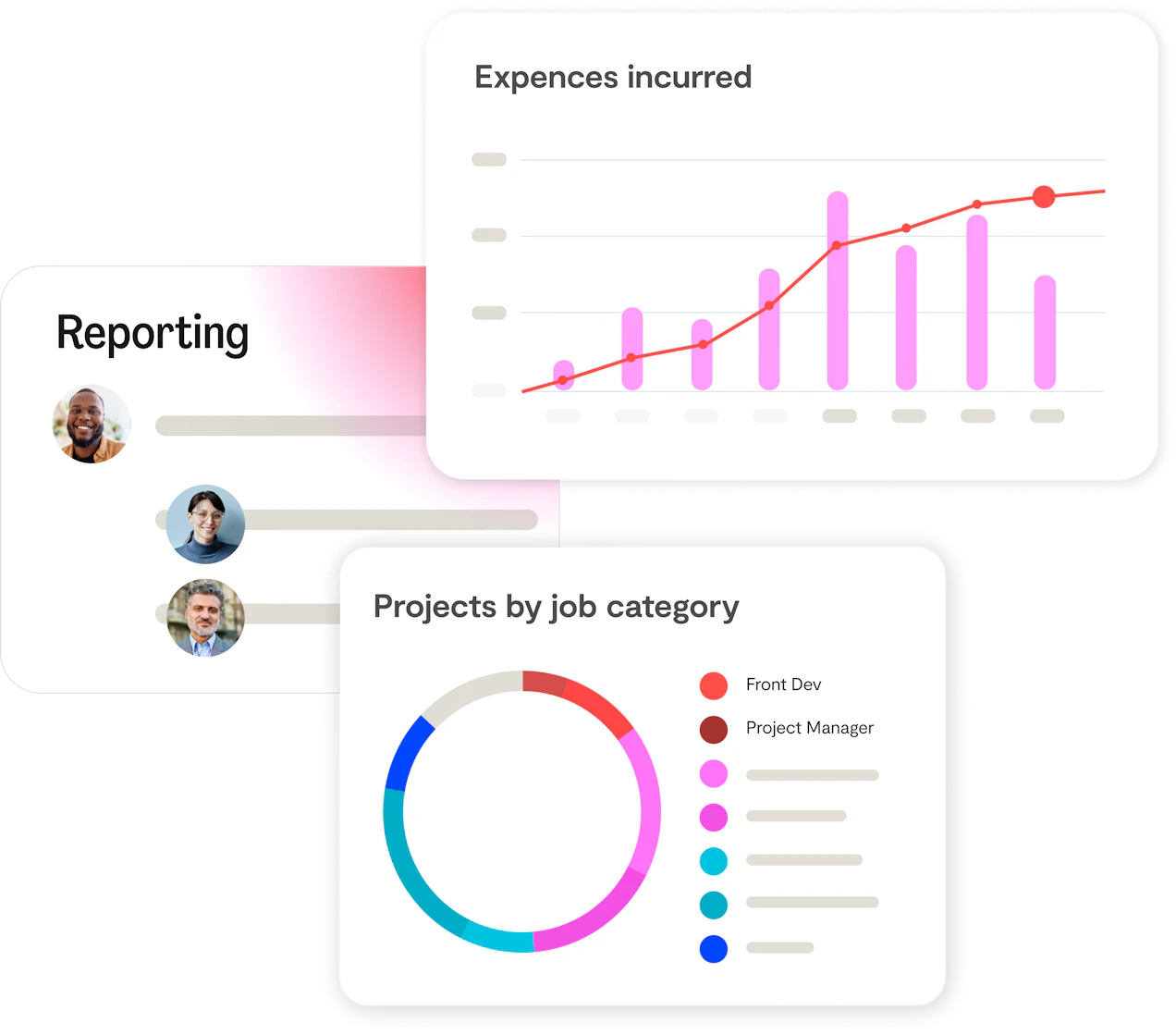
zentral steuern und im Überblick behalten

Klare Mindestvorgaben für Projekt- und Angebotsbeschreibungen sorgen für sauber definierte Projekte und fundierte Angebote.

Detaillierte Leistungsberichte mit klar erfassten Arbeitsergebnissen machen aus vagen Angaben belastbare Nachweise für Selbstständigkeit.

Setzen Sie Freigabegrenzen, um risikoreiche Projekte früh zu erkennen und langfristige Zusammenarbeit gezielt zu prüfen.

Analysieren Sie risikoreiche Projekte gezielt und strukturieren Sie langfristige Einsätze compliant.

Definierte Meilensteine verhindern offene, langfristige Projektstrukturen und binden Zahlungen an konkrete Ergebnisse.

Individuell konfigurierbare Hinweise helfen Ihnen, arbeitsrechtliche Vorgaben in verschiedenen Ländern systematisch einzuhalten.

Hinterlegen Sie Ihre Richtlinien zentral und lassen Sie sie verbindlich bestätigen, bevor Projekte starten.
Geprüfte Selbstständige für jeden Einsatz
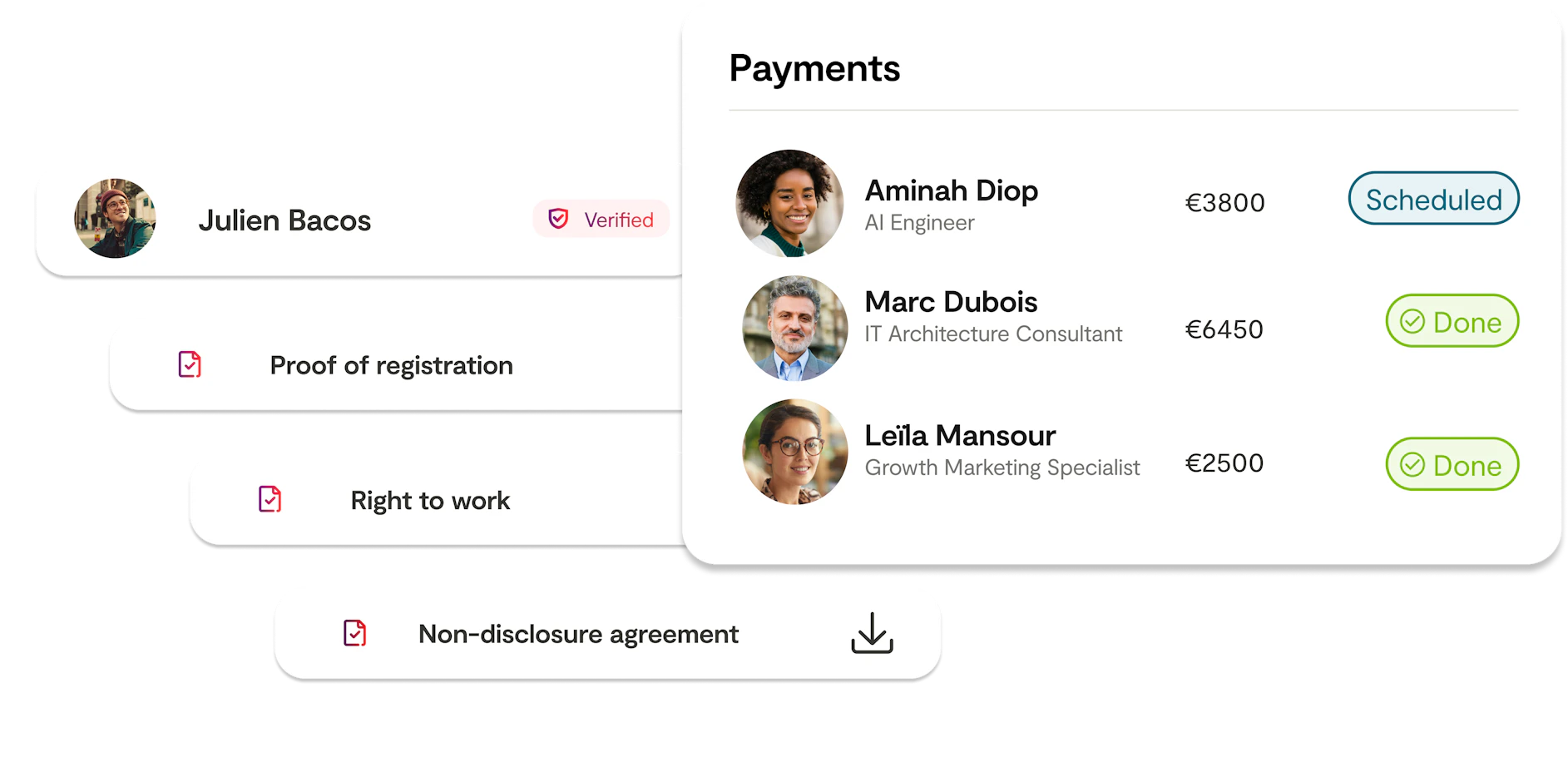
100 % Ihrer Freelancer werden geprüft, bevor Verträge zustande kommen. Ein leistungsstarkes Compliance-Modul prüft Ihre Freelancer regelmäßig und führt länderspezifische Kontrollen in über 130 Ländern aus.
Regelmäßig geprüft und bestätigt (für alle Selbstständigen)
Regelmäßig geprüft und bestätigt (für Einzelunternehmer und Unternehmen)
Einmalige Prüfung zu Beginn der Zusammenarbeit (nur für Unternehmen)
Einmalige Prüfung zu Beginn der Zusammenarbeit (nur für Unternehmen)
Persönliche Unterstützung und lokale Expertise
Mit Standorten in ganz Europa und im Nahen Osten verfügt Malt über fundierte Kenntnisse der lokalen arbeitsrechtlichen Vorgaben. Unsere Teams kennen die regulatorischen Anforderungen in jedem Markt und unterstützen Sie dabei, Verträge jederzeit compliant umzusetzen.

Ein verlässlicher rechtlicher Rahmen
Mit Malt als Unique Provider schaffen Sie die nötige rechtliche Absicherung für Ihre gesamte Zusammenarbeit mit Freelancern. Als vertraglicher Vermittler in jedem Projekt sorgen wir für einen verlässlichen rechtlichen Rahmen und reduzieren den administrativen Aufwand durch Automatisierung.
Sozialversicherungsbeiträge: erfasst und geprüft
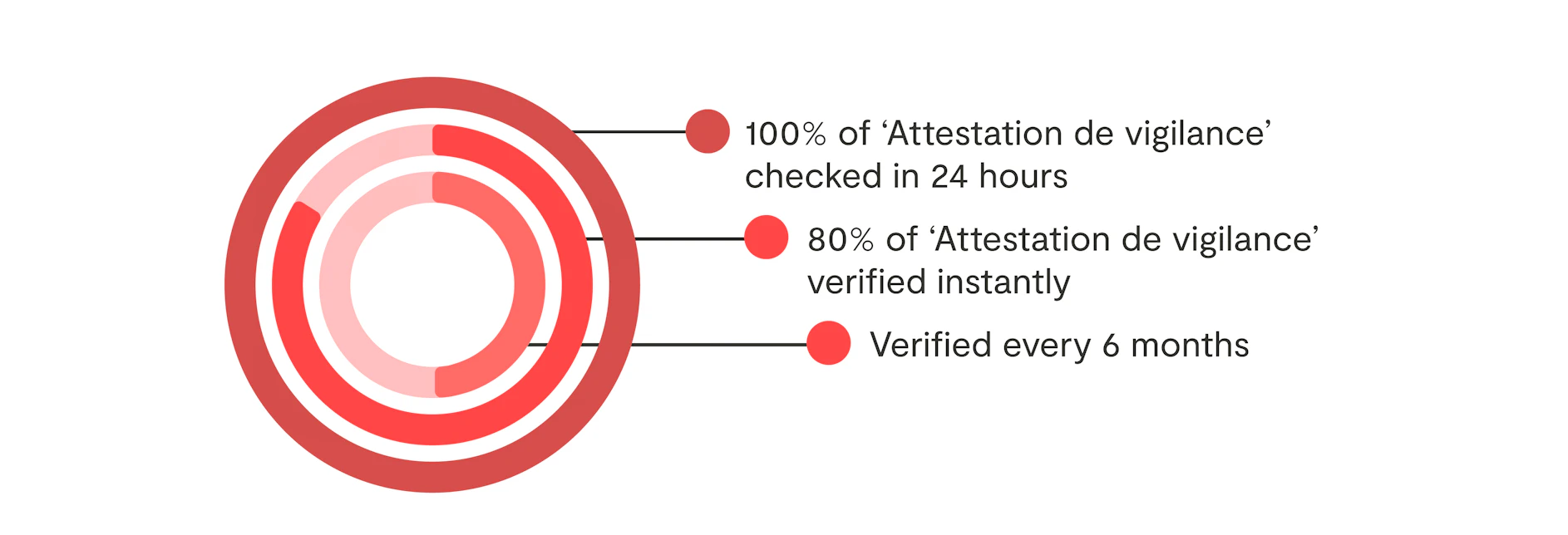
Malt automatisiert die Einholung und Prüfung der „attestation de vigilance“, die in Frankreich von der URSSAF ausgestellt wird, gemäß den geltenden Vorschriften. Regelmäßige Prüfungen und eine 100%ige Verifizierungsquote innerhalb von 24 Stunden stellen sicher, dass Ihre Freelancer während der gesamten Zusammenarbeit compliant bleiben.
Minimieren Sie Ihr rechtliches Risiko. Sprechen Sie mit uns.
FAQ
Misclassification is a term referring to any instance where a worker is incorrectly categorised as an independent contractor instead of an employee. Misclassifying freelancers can result in fines, back taxes, and reputational damage. With the right guidance it can be avoided. Read more >>
Both freelancers and companies are responsible for reducing misclassification. Freelancers are responsible for registering their businesses in accordance with local laws.
On the other hand, companies are responsible for ensuring that their engagement with freelancers complies with local labour and tax laws, including correctly classifying workers. Read more >>
As a part of our thorough checking process, Malt reviews freelancers’ identity and paperwork to ensure they’re compliant with workforce classification and payment regulations.
For freelancers on Malt: we ask for a legal form, company name and address, registration number, and a VAT number (if applicable). Since our payment partners conduct KYC and KYB verifications for freelancers, they may ask them for documents like proof of identity, proof of company registration, and articles of association. In addition, we also verify complementary documents per local regulations (e.g., the attestation de vigilance in France).
For clients using Malt: we ask for the company name, registration number, VAT number, a legal headquarter address and billing information. Read more >>
- IR35 legislation: This ensures freelancers are correctly classified as either self-employed or employees for tax purposes. Businesses need to evaluate working relationships to avoid reclassification.
- Agency worker regulation: Freelancers shall not be placed under the supervision and direction of end clients
- Data protection: Adherence to the Data Protection Act 2018 (aligned with GDPR) is essential when handling freelancer information.
- Conduct regulations: The regulations provide a minimum set of standards that must be adhered to when placing a freelancer into a project
- Post-brexit changes: Cross-border hiring with EU freelancers requires awareness of updated regulations. Read more >>
A Personal Service Company (PSC) is typically a limited company set up by an individual who provides services to clients. Instead of being directly employed by the client, the individual operates their business through this company. Often, the individual is the director and sole or main shareholder of the PSC.
As the individual is employed by his PSC, there can’t be any risk on the labor law side for the end customers. The only risks are related to tax laws.
Employee: An individual who works under a contract of employment. Employees have the most extensive rights, including:
- Statutory Sick Pay
- Statutory Maternity, Paternity, Adoption, and Shared Parental Pay
- Protection against unfair dismissal
- Redundancy pay (after two years of continuous service)
- National Minimum Wage/National Living Wage entitlement
- Working Time Regulations (e.g., limits on working hours, paid holiday)
- Pension auto-enrolment
- Trade union membership rights
Worker: This is a broader category than "employee" and includes individuals who have a more casual or flexible working arrangement. Workers are entitled to some, but not all, employment rights, such as:
- National Minimum Wage/National Living Wage entitlement
- Working Time Regulations (e.g., limits on working hours, paid holiday)
- Protection against discrimination
- Whistleblowing protection
- Right to not have unlawful deductions from wages
Self-Employed: An individual who runs their own business and is responsible for their own taxes and National Insurance contributions. They work for themselves and are not under the control of an employer in the same way as employees or workers. Self-employed individuals have fewer employment rights but have greater autonomy over how they work.
When self employed are hired through a third party like an agency, the Agency Worker Regulation may apply, giving the individual some rights such as having similar conditions than employees after 12 weeks
- Same pay than employee at an equivalent position
- Some time off during the year (unpaid)
A genuinely self-employed individual in the UK typically demonstrates the following characteristics:
- Control: They have significant control over how, when, and where they work. They are not subject to the same level of direction and control as an employee. They have the know-how and own the methodology to deliver their projects.
- Substitution: They have the right to send someone else to do the work if they are unable or unwilling to do it themselves. They can subcontract part of the work. This is encouraged in our standard Malt contracts.
- Financial risk: They bear a significant financial risk in their business, for example the need to rectify unsatisfactory work at their own expense. Ideally they should also provide deliverables (SOW, “fixed price”). On Malt it is possible to select two types of assignments, fixed price or time based.
- Provision of own equipment: They often provide their own equipment and tools necessary for the job. Except when there is a valid reason to do so for ex. Security to access the client systems.
- Advertise themselves and work for multiple clients: They typically work for a number of different clients and are not solely reliant on one source of income. On Malt freelancers are advertising themselves by being visible on the platform to look for additional customers.
- Integration: They are not integrated into the client's organisation in the same way as an employee (e.g., they are not treated as part of the core staff for ex they don’t appear in org charts, they don’t have access to all the employee related communications or intranet…)
HMRC (His Majesty's Revenue and Customs) will consider all aspects of the working relationship when determining employment status.
IR35 specifically applies when an individual provides their services through an intermediary, most commonly a personal service company (PSC). Therefore, IR35 does not directly apply to a self-employed individual working as a sole trader.
However, the fundamental principle behind IR35 – determining whether an individual is genuinely self-employed or effectively an employee in disguise – is still relevant. HMRC can still investigate the working arrangements of a sole trader to ensure they are correctly classified as self-employed for tax purposes.
Our Malt IR35 insurance, also known as tax liability cover or contract review insurance, is designed to protect the end clients against the financial risks associated with an incorrect IR35 status determination. The coverage includes :
Legal Costs: Costs incurred in defending an IR35 investigation by HMRC. This can include solicitor and barrister fees.
Tax Liabilities: Payment of Income Tax and National Insurance Contributions (both employee's and employer's where applicable), as well as potential interest and penalties, if an engagement is deemed inside IR35.
Representation Costs: Costs for tax specialists or advisors to represent the insured party during an HMRC inquiry.
- Malt will guide the freelancer on their adjusted daily rate using our proprietary tax simulator
- The new project price is validated by the customer
- Malt onboards the freelancer on Malt Community Ltd payroll
- The freelancer sends a quote through Malt
- At the end of the month, the client validates the deliverables (or the timesheet)
- Malt pays the freelancer 20 days after
The cost of being deemed inside IR35 can be significant for both the freelancer and, in some cases, the client. In order to achieve a neutral impact on freelancer earnings, we estimate that the cost for a client could be increased by ~20 to 30% due to the following factors :
For the Freelancer:
- Increased Tax and National Insurance: The freelancer will effectively pay Income Tax and National Insurance as an employee on the income from that specific engagement. This can result in a lower net income compared to operating outside IR35, where they might have been able to draw income as dividends (which are taxed differently) or claim certain business expenses.
- Loss of Tax Efficiency: The tax advantages associated with operating through a PSC, such as the ability to control the timing and form of remuneration, may be reduced or eliminated for that particular engagement.
For the Client :
- Employer's National Insurance Contributions: The client becomes liable for employer's National Insurance contributions (currently 15% above £5k) on the deemed salary.
- Apprenticeship Levy: If the client's annual pay bill exceeds £3 million, they will also be liable for the Apprenticeship Levy (currently 0.5% of the total pay bill).
- Administrative Burden: The client needs to operate payroll for the deemed employees, including making deductions and reporting to HMRC. Malt is handling the payroll on behalf of clients so that would not apply if you work with Malt
- Potential Penalties: If the client incorrectly determines the IR35 status and fails to make the correct deductions, they could face penalties from HMRC. Malt is supporting clients to generate accurate SDS and is covering all projects outside IR35 with a special IR35 insurance.
Malt is providing you with a tool to evaluate the Inside IR35 day rate of freelancers taking into account their earnings
Umbrella companies if managed correctly offer a good protection since they deduct NIC and PAYE and offer employment contracts to individuals thus reducing to 0 the employment law risks. However the 2025 budget increases the liability for companies using Umbrella’s in the supply chain, bring back the liability of wrongdoings to the end customer or the fee payer.